- Title
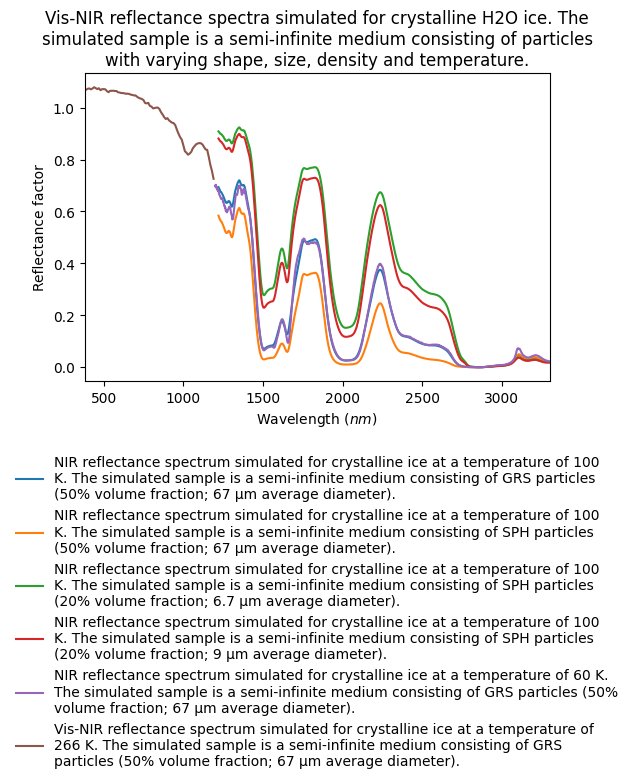
- Vis-NIR reflectance spectra simulated for crystalline H2O ice. The simulated sample is a semi-infinite medium consisting of particles with varying shape, size, density and temperature.
- DOI
- 10.26302/SSHADE/EXPERIMENT_RO_20251101_000
- Data reference
- Ottersberg, Rafael (2025): Vis-NIR reflectance spectra simulated for crystalline H2O ice. The simulated sample is a semi-infinite medium consisting of particles with varying shape, size, density and temperature.. SSHADE/BYPASS (OSUG Data Center). Dataset/Spectral Data. https://doi.org/10.26302/SSHADE/EXPERIMENT_RO_20251101_000
- Publications
- Database(s)
- Experimentalists
- Type(s)
- numerical modeling
- Description
- The gaussian random sphere (GRS) or spherical (SPH) particles were generated following a measured size distribution of SPIPA-B. The size was scaled to different mean diameters. They were packed to a volume fraction of 20% or 50% in a semi-infinite medium. The reflectance factor was simulated for i=0° e=25°.
- Number of spectra
- 6
- Variable type(s)
-
- temperature
- sample grain size
- Standard medium
- vacuum
- Observation mode
- spectrum
- Spectral range type(s)
- Vis, NIR, MIR
- Valid spectral range(s)
-
Min - Max ($nm$) Sampling ($nm$) Resolution ($nm$) Position accuracy ($nm$) Absorption edge #1 380.0 - 1190.0 10.0 10.0 #2 1220.0 - 3300.0 2.5 17.5
Definition: incidence and emergence angles are positive with origin at nadir, and vary in same direction. Azimuth origin (increasing clockwise) is for i = e (opposition geometry).
- Observation geometry
- directional-conical
- Observation mode
- fixed angles
- Incidence angle
- 0.0°
- Emergence angle
- 25.0°
- Azimuth angle
- 0.0°
- Phase angle
- 25.0°
- Observation mode
- single spot
- Spots number
- 4
- Date begin - end
- 2025-11-01 - 2025-11-01
Versions
- Release date
- 2026-03-11 21:18:02+0000 UTC
- Version (Date)
- #1 (2026-03-11 21:18:02+0000 UTC, Updated: 2026-03-11 21:18:02+0000 UTC)
- Sponsors
-
- National Center for Competence in Research (NCCR) Swiss National Science Fundation (NCCR PlanetS)