Experiment
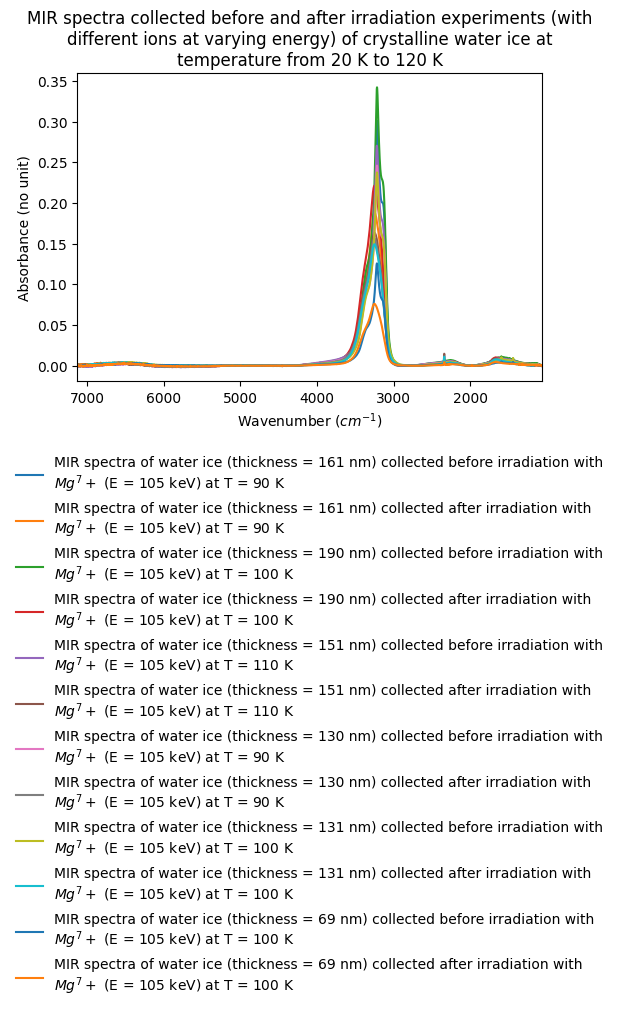
MIR spectra collected before and after irradiation experiments (with different ions at varying energy) of crystalline water ice at temperature from 20 K to 120 K
Sub-Experiment
$Mg^7+$ E=105 keV
Sub-Experiment
$Mg^5+$ E=56 keV
Sub-Experiment
$Mg^3+$ E=36 keV
Sub-Experiment
$S^7+$ E=126 keV
Sub-Experiment
$S^7+$ E=87 keV
Sub-Experiment
$S^7+$ E=49 keV
Sub-Experiment
$O^6+$ E=108 keV
Sub-Experiment
$O^6+$ E=80 keV
Sub-Experiment
$O^6+$ E=50 keV
- Title
- MIR spectra collected before and after irradiation experiments (with different ions at varying energy) of crystalline water ice at temperature from 20 K to 120 K
- DOI
- 10.26302/SSHADE/EXPERIMENT_LB_20250630_001
- Data reference
- Moingeon, Audrey; Quirico, Eric; Poch, Olivier; Faure, Mathilde; Boduch, Philippe; Domaracka, Alicja; Rothard, Hermann (2024): MIR spectra collected before and after irradiation experiments (with different ions at varying energy) of crystalline water ice at temperature from 20 K to 120 K. SSHADE/GhoSST (OSUG Data Center). Dataset/Spectral Data. https://doi.org/10.26302/SSHADE/EXPERIMENT_LB_20250630_001
- Publications
- Database(s)
- Experimentalists
- Type(s)
- laboratory measurement
- Description
- MIR spectra of the initial crystalline water ice (Ih or Ic - thickness varying from 44 to 214 nm) and of the amorphous water ice resulting from irradiation (with different ions at varying energy) at temperature from 20K to 120K
- Number of spectra
- 96
- Variable type(s)
-
- irradiation type
- irradiation dose
- temperature
- Comments
- the thickness of the sample is also varying but was not a key parameter for this series of spectra - the flux is also varying but not in a systematic manner
- Instrument
- Bruker 70V - transmisson Mid-IR
- Sample holder
- ZnSe 13 mm diameter and 2 mm thickness
- Standard medium
- vacuum
- Observation mode
- spectrum
- Spectral range type(s)
- MIR
- Valid spectral range(s)
-
Min - Max ($cm^{-1}$) Sampling ($cm^{-1}$) Resolution ($cm^{-1}$) Position accuracy ($cm^{-1}$) Absorption edge #1 1064.0 - 7128.0 0.96 2.0
Definition: incidence and emergence angles are positive with origin at nadir. Emergence angle in transmission is larger than 90° (=180°-i).
- Observation geometry
- direct
- Observation mode
- fixed angles
- Incidence angle
- 0.0°
- Emergence angle
- 180.0°
- Azimuth angle
- 0.0°
- Phase angle
- 180.0°
Illumination
Observation
- Comments
- possibly partly polarized beam by beamsplitter
- Observation mode
- single spot
- Image size
- 1.5 x 1.5 $mm$
- Date begin - end
- 2024-07-09 - 2024-10-11
Versions
- Release date
- 2026-02-23 08:37:22+0000 UTC
- Version (Date)
- #1 (2026-02-23 08:37:22+0000 UTC, Updated: 2026-04-03 08:46:03+0000 UTC)
- Sponsors
-
- ANR PREparing Jupiter's SyStem Exploration with JWST (ANR) (ANR PRESSE)
- CNES (through MAJIS/JUICE)