Experiment
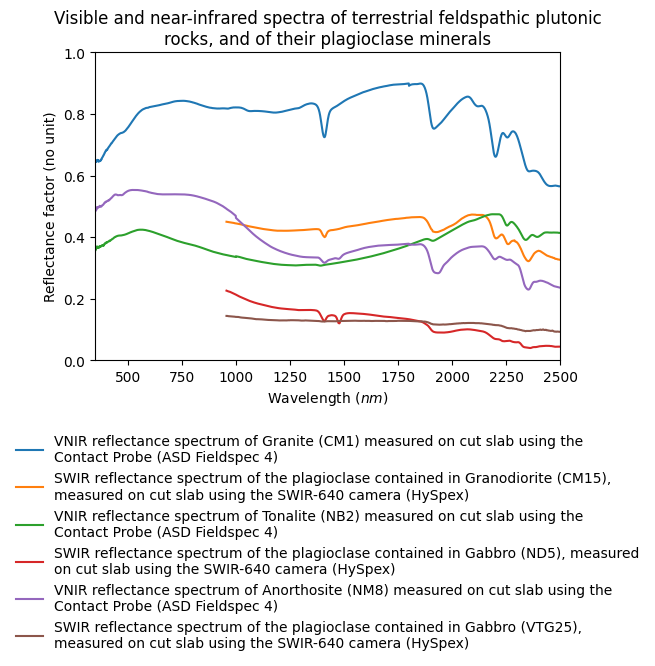
Visible and near-infrared spectra of terrestrial feldspathic plutonic rocks
Sub-Experiment
Anorthosite
Sub-Experiment
Gabbro
Sub-Experiment
Granite
Sub-Experiment
Granodiorite
- DOI
- 10.26302/SSHADE/EXPERIMENT_MB_20260302_0002
- Data reference
- Barthez, Marie (2022): Visible and near-infrared spectra of terrestrial feldspathic plutonic rocks. SSHADE/Mirabelle (OSUG Data Center). Dataset/Spectral Data. https://doi.org/10.26302/SSHADE/EXPERIMENT_MB_20260302_0002
- Database(s)
- Experimentalists
- Type(s)
- laboratory measurement
- Description
- Visible Near-Infrared spectra.
- Number of spectra
- 86
- Variable type(s)
-
- sample composition
- Standard medium
- unknown
- Observation mode
- spectrum
- Spectral range type(s)
- Vis, NIR
- Valid spectral range(s)
-
Min - Max ($nm$) Sampling ($nm$) Resolution ($nm$) Position accuracy ($nm$) Absorption edge #1 350.0 - 1000.0 1.4 3.0 0.5 #2 1001.0 - 2500.0 1.1 10.0 0.5 - Comments
- Measurements were made between 350nm and 2500nm.
Definition: incidence and emergence angles are positive with origin at nadir, and vary in same direction. Azimuth origin (increasing clockwise) is for i = e (opposition geometry).
- Observation geometry
- bidirectional
- Observation mode
- fixed angles
- Incidence angle
- 45.0°
- Resolution illumination
- 0.5°
- Resolution observation
- 25.0°
- Observation mode
- single spot
- Standard medium
- unknown
- Observation mode
- spectrum
- Spectral range type(s)
- Vis, NIR
- Valid spectral range(s)
-
Min - Max ($nm$) Sampling ($nm$) Resolution ($nm$) Position accuracy ($nm$) Absorption edge #1 960.0 - 2500.0 4.38 1.4 - Comments
- Measurements were made between 960nm and 2500nm.
Definition: incidence and emergence angles are positive with origin at nadir, and vary in same direction. Azimuth origin (increasing clockwise) is for i = e (opposition geometry).
- Observation geometry
- bidirectional
- Observation mode
- fixed angles
- Resolution observation
- 1.4°
- Observation mode
- image
- Spatial resolution
- 0.032 $mm$
- Comments
- Values valid for the use of microscopic lense.
- Date begin - end
- 2022-06-01 - 2023-10-17
Versions
- Release date
- 2026-03-26 17:05:20+0000 UTC
- Version (Date)
- #1 (2026-03-26 17:05:20+0000 UTC, Updated: 2026-06-04 19:29:07+0000 UTC)
- Sponsors
-
- Agence Nationale de la Recherche, ANR-21-CE49-0003, Dr. Jessica Flahaut (ANR Mars-SPEC)